Firearms, Ammunition, and Materials
Lua animation API 1: New animation data lives in pack scripts under
config. JSON animation fragments below explain the data structure and legacy compatibility; do not duplicate them alongside Lua. See Lua animation machines and the parameter reference.
Ammunition
An ammunition definition owns caliber identity, damage/ballistics, inventory icon, loaded-round model, and spent-case model. A weapon references compatible ammunition IDs; magazines change capacity and animation behavior but do not replace the caliber definition.
Keep loaded rounds and spent cases under assets/<namespace>/gltf/bullets/, with base-color, normal, and specular textures under skins/bullets/. Each cartridge type may provide a different case model, so ejection follows the currently loaded ammunition.
Firearm behavior JSON
Start from the closest official example: magazine-fed rifle, pistol, tube-fed shotgun, or bolt-action rifle. Important groups include:
- identity, class, compatible ammunition, capacity, chamber behavior;
- fire mode, rate, range, damage, projectile count, and spread;
- reload/rechamber state and event frames;
- hip/ADS recoil and Weapon Sway;
- animation interruption and action timing;
- default and optional attachment slots.
Do not copy shotgun shell-loop rules into a detachable-magazine weapon, or automatic scheduling into a bolt-action weapon.
Magazine-fed finite actions use mechanics.action_commit_ms. A tube-fed shotgun with reload_system.type: "tube_per_round" instead authors only the event frames under reload_system.events; runtime derives server timing from animation_fps, so do not add duplicate per-round *_ms fields.
Use creative_category to select both the creative-tab group and the weapon-type label shown in the modification screen. Standard values are assault_rifle, battle_rifle, submachine_gun, shotgun, light_machine_gun, marksman_rifle, sniper_rifle, pistol, launcher, and melee. creative_sort controls ordering within a category. Unknown values fall back to assault_rifle.
An ordinary firearm's registered item ID also follows its category, such as gwo:assault_rifle, gwo:shotgun, or gwo:pistol. A firearm with transformation uses gwo:transforming_gun in both forms. Melee weapons still use gwo:melee_weapon. The item component continues to identify the particular content-pack weapon, so content definition IDs such as example:example_rifle do not change.
The old gwo:gun registration has been removed without automatic migration of saved items. Back up your world and deal with guns in inventories and containers on the older version before upgrading; afterward, restore them with /gwo give firearm "<namespace>:<weapon ID>" or the gunsmith workbench. Workbench result.id still takes a content definition ID, not the registered item ID. See the gunsmith workbench guide.
Dual-form firearms
Two firearm definitions must point transformation.target at each other: form A targets example:form_b, and form B targets example:form_a. state names that direction's transform animation, duration_ms is the logical lock duration (100–10000 ms), and display_root defaults to tag_weapon. Both definitions must use the same magazine capacity, ammo settings, module tree, and model reference. They are two forms of one item, retaining its ammunition. Validate animation, reload, ADS, and audio in both directions.
Firearm render JSON
The render file binds model, animation library, arms, materials, nodes, action names, and display transforms. Typical declarations include:
{
  "gltf_model": "example:gltf/guns/example_rifle/example_rifle_receiver_default.glb",
  "animation_sources": [
    "example:gltf/animations/example_rifle_receiver_default.anim.glb"
  ],
  "texture": "example:skins/guns/example_rifle.png",
  "normal": "example:skins/guns/example_rifle_n.png",
  "specular": "example:skins/guns/example_rifle_s.png"
}
Define transforms independently for first person, third-person pose, offhand stow, modification screen, fixed/item-frame display, and dropped items. A display transform should use the static model pose rather than an authored idle clip.
Recoil and Weapon Sway
Hip and ADS recoil are separate parameter sets. vertical and horizontal control view recoil; model_back controls model-space rearward impulse; randomness and recovery shape variation and return. auto_recovery: false disables automatic view return for weapons that require manual correction.
Weapon Sway is a spring-like location/rotation offset around the authored pose. It must not be baked into animation clips and must be consumed consistently by the weapon, muzzle, tracers, lasers, and magnified-optic path.
Muzzle effects and projectiles
tag_flash supplies the muzzle origin, while the actual projectile remains authoritative for collision and damage. Tracers are visual segments that begin at the animated muzzle and converge toward the physical trajectory. Shotguns create one physical pellet/tracer path per configured pellet, not one decorative beam for the whole shot.
Use tracer.count_interval: 0 whenever every shot must display a tracer. Validate high-velocity ammunition at short, medium, and long range: every first-person muzzle event should still create its visual tracer even when the authoritative projectile hits or leaves view almost immediately. If only one weapon is affected, inspect that ammunition's own tracer configuration before changing fire rate or animation event frames.
Muzzle flash and smoke use separate resources. Verify both first and third person, with and without shaders, while moving the camera quickly. Spent cases originate at tag_brass and use the currently loaded ammunition's case model.
Texture channels
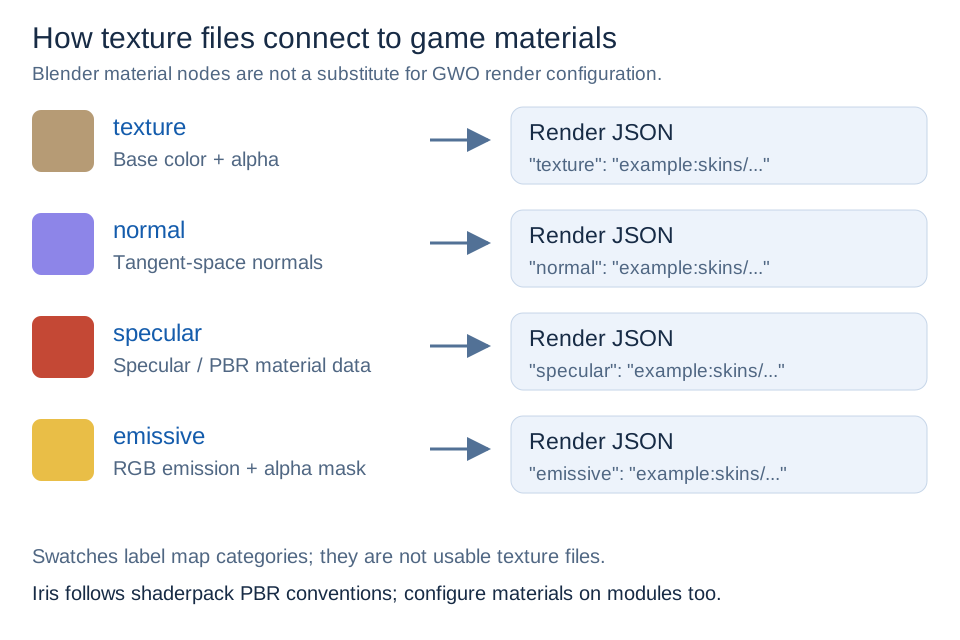
- Base color:
*.png - Tangent-space normal:
*_n.png - GWO packed material/specular map:
*_s.png - Optional emissive mask:
*_glow.png
Every default part should explicitly declare the shared base, normal, and specular textures when it uses them. Do not assume a detached part automatically inherits all receiver maps.
Configuration examples
These examples use the same fields as the Chinese reference. Replace resource IDs, timings, and model-specific nodes with your own. json blocks are JSON objects; jsonc blocks are fragments to merge, not standalone pack files. Valid JSON alone does not make a complete working weapon.
Ammunition definition (bullets/example_ammo.json)
{
  "id": "example:example_ammo",
  "display_name": "Example Ammunition",
  "family": "example:example_caliber",
  "icon_model_data": 2001,
  "ballistics": {
    "max_entity_hits": 1
  },
  "tracer": {
    "count_interval": 0,
    "color": "#FFFFEBA0",
    "size_multiplier": 1.0,
    "length_multiplier": 1.0
  },
  "models": {
    "cartridge": {
      "model": "example:gltf/bullets/unspent_example_ammo.glb",
      "texture": "example:skins/bullets/example_ammo.png",
      "normal": "example:skins/bullets/example_ammo_n.png",
      "specular": "example:skins/bullets/example_ammo_s.png",
      "specular_strength": 0.55,
      "roughness_value": 0.35,
      "metallic_value": 0.85
    },
    "casing": {
      "model": "example:gltf/bullets/spent_example_ammo.glb",
      "texture": "example:skins/bullets/example_ammo.png",
      "normal": "example:skins/bullets/example_ammo_n.png",
      "specular": "example:skins/bullets/example_ammo_s.png",
      "specular_strength": 0.55,
      "roughness_value": 0.35,
      "metallic_value": 0.85
    }
  }
}
Firearm gameplay definition (weapons/firearms/example_rifle.json)
{
  "id": "example:example_rifle",
  "display_name": "Example Rifle",
  "creative_category": "assault_rifle",
  "creative_sort": 100,
  "model_data": 2000,
  "magazine_size": 30,
  "ammo": {
    "default": "example:example_ammo",
    "accepted_families": ["example:example_caliber"]
  },
  "damage": 8.0,
  "range": 96.0,
  "ballistics": {
    "muzzle_velocity": 500.0,
    "gravity": 9.8,
    "drag": 0.015,
    "water_drag": 0.6,
    "life_seconds": 2.5,
    "hitbox_inflation": 0.12,
    "headshot_multiplier": 1.5,
    "headshot_height_fraction": 0.25,
    "damage_curve": [
      {"distance": 0, "multiplier": 1.0},
      {"distance": 32, "multiplier": 1.0},
      {"distance": 64, "multiplier": 0.85},
      {"distance": 96, "multiplier": 0.65}
    ]
  },
  "inaccuracy": {
    "stand": 5.0,
    "move": 5.5,
    "sneak": 2.75,
    "lie": 1.5,
    "aim": 0.1
  },
  "mechanics": {
    "rpm": 600,
    "fire_interval_ms": 100,
    "action_commit_ms": {
      "reload": 1300,
      "reload_empty": 1800,
      "reload_ads": 1300,
      "reload_empty_ads": 1800,
      "melee": 233
    }
  },
  "fire_modes": ["auto", "semi"],
  "render": "weapons/firearms/render/example_rifle.render.json"
}
Render-definition starting structure (not a complete animation machine)
{
  "gltf_model": "example:gltf/guns/example_rifle/example_rifle_receiver_default.glb",
  "animation_sources": [
    "example:gltf/animations/example_rifle_receiver_default.anim.glb"
  ],
  "texture": "example:skins/guns/example_rifle.png",
  "normal": "example:skins/guns/example_rifle_n.png",
  "specular": "example:skins/guns/example_rifle_s.png",
  "icon_texture": "example:textures/item/guns/example_rifle.png",
  "modules": {
    "example_rifle_barrel_default": "attachments/barrels/example_rifle_barrel_default.json",
    "example_rifle_mag_default": "attachments/magazines/example_rifle_mag_default.json"
  },
  "animation_controller": {
    "channels": {
      "idle": {
        "clip": "idle",
        "layer": "base",
        "loop": true
      },
      "raise": {
        "clip": "raise",
        "layer": "action",
        "loop": false
      },
      "drop": {
        "clip": "drop",
        "layer": "action",
        "loop": false
      },
      "fire": {
        "clip": "fire",
        "layer": "recoil",
        "loop": false
      },
      "reload": {
        "clip": "reload",
        "layer": "action",
        "loop": false
      },
      "reload_empty": {
        "clip": "reload_empty",
        "layer": "action",
        "loop": false
      }
    }
  },
  "gltf_scale": 0.075,
  "first_person": {
    "anchor_node": "tag_camera",
    "camera_node": "tag_view",
    "use_camera_transform": true,
    "translation": {"x": 0, "y": 0, "z": 0},
    "rotation": {"x": 0, "y": 0, "z": 0},
    "scale": 1
  },
  "first_person_arms": true,
  "arms": {
    "model": "example:gltf/arms/arms.glb"
  },
  "shell_effect": {
    "anchor_bone": "tag_brass"
  }
}
Weapon sway and recoil (merge into render definition)
"weapon_sway": {
  "enabled": true,
  "hip": {
    "input_gain": 9.0,
    "deadzone": 0.18,
    "max_angle": 5.5,
    "stiffness": 64.0,
    "damping": 15.0,
    "edge_damping": 8.0,
    "location_gain": 0.09,
    "roll_gain": 0.45
  },
  "ads": {
    "input_gain": 4.0,
    "deadzone": 0.06,
    "max_angle": 1.2,
    "stiffness": 80.0,
    "damping": 18.0,
    "edge_damping": 10.0,
    "location_gain": 0.06,
    "roll_gain": 0.35
  }
},
"recoil": {
  "enabled": true,
  "blend_start": 0.15,
  "blend_end": 0.95,
  "blend_curve": "smoothstep",
  "hip": {
    "vertical": 1.0,
    "horizontal": 1.0,
    "model_back": 5.0,
    "randomness": 1.0,
    "recovery": 0.8
  },
  "ads": {
    "vertical": 1.0,
    "horizontal": 1.0,
    "model_back": 7.0,
    "randomness": 1.0,
    "recovery": 0.8
  }
}
Muzzle/tracer options (merge into render definition)
"bullet_tracer": {
  "enabled": true,
  "size_multiplier": 1.0,
  "length_multiplier": 1.0
},
"shell_effect": {
  "anchor_bone": "tag_brass"
}
Material paths (merge into render definition)
"texture": "example:skins/guns/example_rifle.png",
"normal": "example:skins/guns/example_rifle_n.png",
"specular": "example:skins/guns/example_rifle_s.png",
"emissive": "example:skins/guns/example_rifle_glow.png",
"emissive_strength": 1.0
Transparent nodes (merge into render definition)
"transparent_nodes": {
  "lens_glass": {
    "alpha": 0.8,
    "depth_write": false,
    "depth_test": true,
    "double_sided": true
  }
}
Field meanings and checks
familyis the ammunition family accepted by the weapon, not its filename.models.cartridgeis the loaded/unfired cartridge;models.casingis the spent case.magazine_sizeis configured magazine capacity. Reload commit time, not a sound frame, changes ammunition.- Keep
60000 / mechanics.rpmconsistent withmechanics.fire_interval_ms. inaccuracycontrols direction spread; view recoil and authored fire animation are separate.j_ammo_01,j_ammo_02, etc. locate visible rounds. Ammo/follower animations belong to their dedicated state layers.- The render structure above references default modules. Provide those files and an animation machine; for the beginner one-piece weapon use First Firearm.
| Transform field | Display context |
|---|---|
first_person | First-person base transform |
offhand_stowed | Weapon stowed on the body from offhand |
third_person_pose | Third-person arms and weapon |
ground | Dropped weapon |
fixed | Item frame |
modify_screen | Modification preview |
gltf_scale | Overall model-to-game scale |
Scene-specific scales do not replace correct model units. Static displays should not depend on a moving first-person idle animation.
Material details: base color includes alpha; normals are tangent-space. The non-shaderpack path reads the specular red channel as a highlight mask, while Iris PBR interpretation depends on the shaderpack. Separate roughness and metallic textures can be used, with roughness_value and metallic_value as scalar settings when maps are absent. Emissive RGB supplies color, alpha supplies its mask, and emissive_strength controls strength. Transparent glass must be a separately named mesh.
For independent teaching configurations without default-pack assets, see Configuration Examples. Existing valid fields and explicit defaults should be preserved when merging examples.